
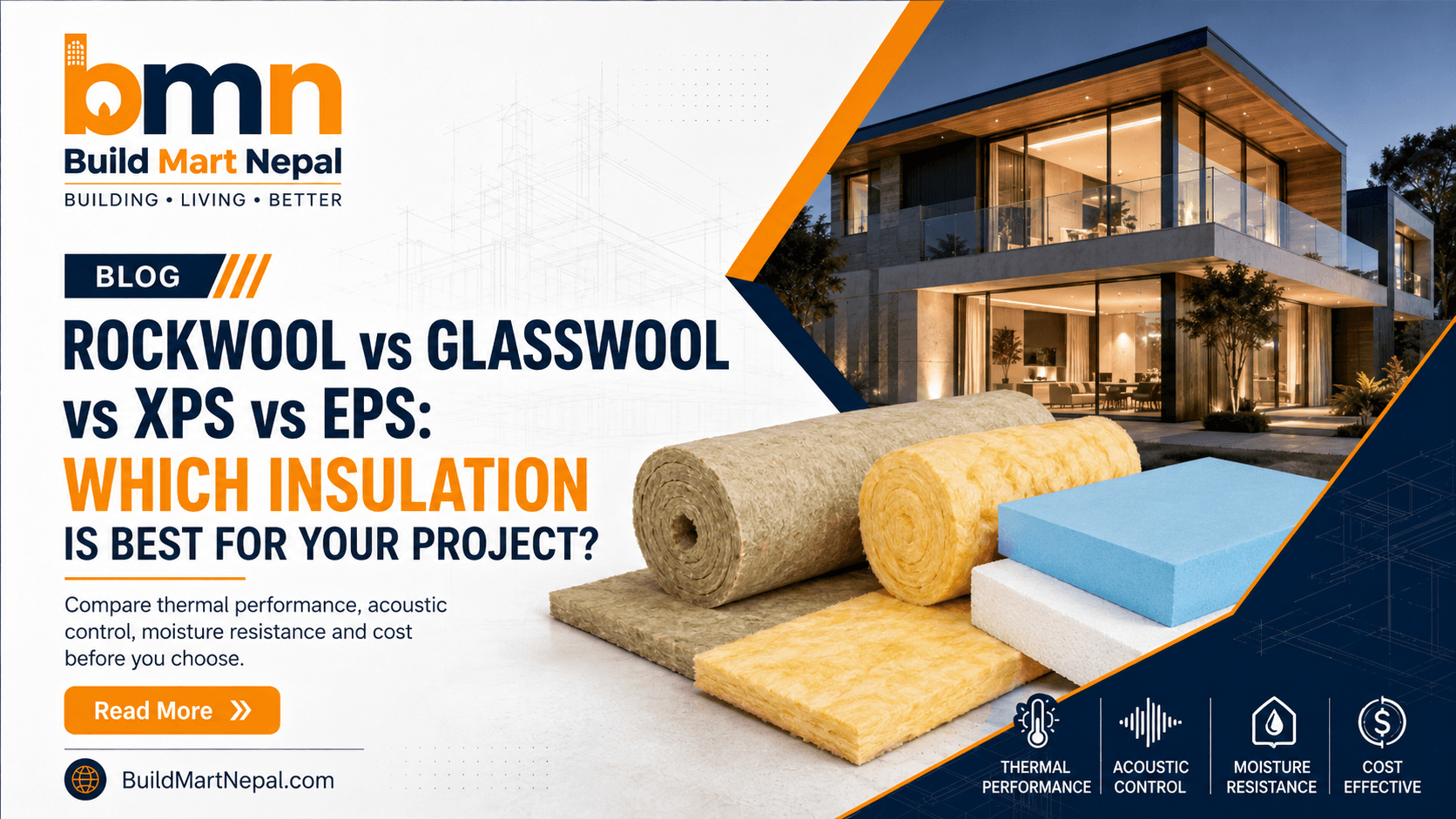
Rockwool vs Glasswool vs XPS vs EPS: Which Insulation Is Best for Your Project?
Comparing thermal performance, acoustic control, moisture resistance and cost across the four most common insulation materials sold in Nepal.
Rockwool, glasswool, XPS and EPS all get sold as 'insulation' in Nepal, but they solve different problems — picking by price alone is how projects end up with the wrong material for the application.
Thermal performance
All four perform in a broadly similar thermal conductivity range (roughly 0.030-0.040 W/mK), but XPS holds its R-value best under sustained moisture exposure, making it the standard choice for below-grade and roof applications where the insulation may see occasional dampness.
Acoustic control
Rockwool's density gives it the clear edge for sound absorption, which is why it dominates soundproofing wall and ceiling assemblies. Glasswool performs reasonably for acoustic use at a lower cost; XPS and EPS, being closed-cell rigid foams, contribute very little to sound absorption.
Moisture resistance
XPS (extruded polystyrene) has near-zero water absorption and is the go-to for foundation, roof and cold-storage insulation where load-bearing capacity and moisture exposure both matter. EPS (expanded polystyrene) absorbs more moisture over time and costs less, making it common for non-critical wall infill. Rockwool and glasswool are not moisture-tolerant and need a vapor barrier in humid applications.
Fire safety
Rockwool is non-combustible (Class A1) and the default for fire-rated partitions. Glasswool is also non-combustible. XPS and EPS are combustible foams and need a fire-retardant grade plus appropriate detailing when used near escape routes or fire-rated assemblies.
Cost and where each one wins
Glasswool is typically the cheapest for large-volume roof insulation. Rockwool costs more but pays back in fire-rated or high-acoustic-demand applications. XPS costs the most per board but is the only real choice for below-grade or load-bearing insulation. EPS sits between glasswool and XPS in cost for general wall/roof infill where moisture and fire risk are both low.
Choosing for your project
For a quick decision: soundproofing → rockwool; budget roof insulation → glasswool; foundation, roof deck or cold storage → XPS; general low-risk wall infill → EPS. Compare verified insulation material listings by density and thickness, not just brand.
NepalBuild Admin
Content Team · BuildMartNepal.com — Nepal's construction materials marketplace
Similar articles

Fire-Rated Insulation Materials: What Nepali and Indian Building Codes Require
A practical overview of fire-rating requirements for insulation materials under Nepal's National Building Code and comparable Indian standards.

PUF Panels vs Traditional Brick Walls: Speed and Cost Compared for South Asia
Prefabricated PUF sandwich panels are reshaping fast-track construction across Nepal, India and neighboring markets — here's how they actually compare to brick.

Thermal Insulation for Hot Climates: Lessons from Nepal's Terai and India
Insulation isn't just for cold regions — how Nepal's Terai belt and Indian cities use thermal insulation to cut cooling costs.
Rockwool vs Glasswool Insulation: Which Is Best for Nepal's Climate?
A side-by-side comparison of the two most common thermal and acoustic insulation materials sold in Nepal, India and the wider South Asian market.